


When Work Leaves the Meeting but Not Your Mind
A task gets assigned. Everyone leaves the meeting thinking it is moving. Then it comes back. This week’s blog explains why follow-through weakens when ownership exists in conversation but not in the system.
The Problem
A decision gets made.
A task gets assigned.
Everyone leaves thinking it is moving.
Then it comes back.
A detail was never documented.
A handoff was assumed.
The next person cannot tell what was decided.
That is where follow-through weakens.
The work did not stop.
The clarity disappeared when it changed hands.
Now the leader is back inside it.
Questions resurface.
Momentum thins quietly.
In many businesses, ownership exists in conversation.
It does not hold in the system.
People remember the meeting.
They cannot show what happened next.
That gap creates drag.
It creates rework.
It creates delays.
It turns the owner into the tracking system.
The Shift
Istanbul, around 1570.
Inside the Ottoman imperial court, petitions did not move forward on verbal assurance alone.
A written petition entered the system.
Clerks logged it.
Officials reviewed it.
Notes and routing marks sent it to the next stage.
That sequence did more than move paper.
It kept responsibility visible as the work changed hands.
A petition could be delayed.
It could be redirected.
It could wait on judgment at a higher level.
But it was not supposed to disappear into vague custody.
Its path had to stay legible to the people inside the system.
Visible handoffs make follow-through stronger.
The record carried responsibility forward before the next person had to guess.
What To Do
1. Define what must be visible
Do not call work complete because someone said it was handled.
Define what the next person must be able to see.
• The owner
• The next step
• The due date
• The key decision
Visible completion reduces confusion at the moment of transfer.
2. Require one clear handoff signal
Every recurring handoff needs one simple proof.
That might be a status change.
A closing note.
A logged next action.
A written acknowledgment.
Keep it simple.
But make it visible.
A handoff signal keeps work from slipping into vague custody.
3. Review what comes back
When work returns, do not treat it as a random annoyance.
Treat it as evidence.
Ask:
• Where did the trail disappear?
• What was assumed instead of shown?
• What did the next person need but not receive?
That review shows you where the system is still too soft.
The Heartbeat
Good leaders should not have to carry every thread by memory.
That is not stewardship.
That is overload.
A stronger system respects the team and the leader at the same time.
It makes ownership clearer.
It makes follow-through fairer.
It makes momentum more durable.
When the trail is visible, people can move with more confidence.
Next Step
Where in your business does work keep coming back because the handoff left no clear trail?

When Work Has to Travel, Constraints Become the Strategy
Execution problems rarely appear where work begins.
They surface later, after handoffs, distance, or time.
This post explores why constraints installed early allow work to hold together long after the original decisions are made.
The Problem
Execution problems rarely show up where work begins.
They show up later.
After handoffs.
After distance.
After time.
Early on, effort is high.
Attention is sharp.
Decisions feel manageable.
Then the work moves.
It passes to another person.
Another team.
Another week.
That is where progress slows.
Not because people stop caring.
Not because capability disappears.
But because judgment is still required long after it should have been settled.
When work depends on future interpretation, execution becomes fragile.
The longer work has to travel, the more exposed it becomes to delay, rework, and confusion.
The Shift
Strong execution is not maintained by supervision.
It is maintained by decisions made early enough to survive distance and time.
In late 12th century France, the builders of Chartres Cathedral faced a problem most modern teams underestimate.
The cathedral would take decades to complete.
Some craftsmen would never see it finished.
Stonecutters shaped blocks miles away from the site.
Masons who set those stones often never met the men who cut them.
And yet the stones fit.
Each block was carved to fixed dimensions.
Each surface cut to established tolerances.
Each stone marked with standardized symbols.
Those marks told future masons where the stone belonged and how it was meant to sit.
Years could pass between cutting and placement.
Hands could change.
Generations could turn over.
The work continued because interpretation was already decided.
Standardized marks and dimensions removed judgment at the moment of assembly.
That distinction is easy to overlook.
Execution does not fail because people lack effort or care.
It fails when unresolved judgment is pushed downstream.
What to Do
If work in your organization must travel, across people, time, or context, constraints are not optional. They are the strategy.
Here are practical ways to install them.
1. Define “ready” before work moves
Most rework happens because work is passed along before it is truly complete.
Write a single sentence that answers:
What must be true before this work can move forward?
This removes negotiation at the handoff.
2. Reduce interpretation at transitions
Look for moments where someone has to ask,
“What did you mean by this?”
That question is a signal.
Judgment has been deferred too long.
Clarify earlier.
3. Standardize what should not vary
Not everything needs freedom.
Identify the elements that should look the same every time and lock them down.
Templates, formats, definitions, sequences.
Variation belongs where it adds value, not where it adds friction.
4. Make decisions durable
If a decision keeps resurfacing, it was never truly decided.
Capture it in writing.
Attach it to the work.
Make it visible.
Durable decisions reduce leader involvement later.
5. Design for absence
Ask a hard question.
If you were unavailable for a week, would execution hold?
If not, the work depends too heavily on real time judgment.
That is where constraint belongs next.
The Heartbeat
The best work is not held together by vigilance.
It is held together by clarity that arrives early and stays intact.
When work is designed to outlast the moment, execution becomes steadier, quieter, and more resilient.
Constraints do not slow progress.
They allow it to travel.
The Next Step
Where is your work slowing down today
because judgment is still being made too late?
Busy Isn’t the Same as Progress
Why execution often slows before anything looks broken—and how unclear handoffs quietly prevent work from compounding.
The Problem
The hardest execution problems to fix
are the ones that don’t look like problems yet.
Calendars are full.
People are working.
Decisions are being made.
Updates are happening.
From the outside, everything looks productive.
But underneath the activity, progress is stalling.
Work piles up between roles.
Decisions get revisited.
Leaders keep stepping back into work they thought they had already handed off.
Nothing is obviously broken—and that’s what makes it dangerous.
Because when nothing is clearly broken, leaders default to pushing harder:
More speed
More urgency
More communication
Yet results still don’t compound.
The core issue usually isn’t effort or competence.
It’s that work is changing hands before it’s truly ready to move.
The Shift
The shift is learning to see execution as flow, not activity.
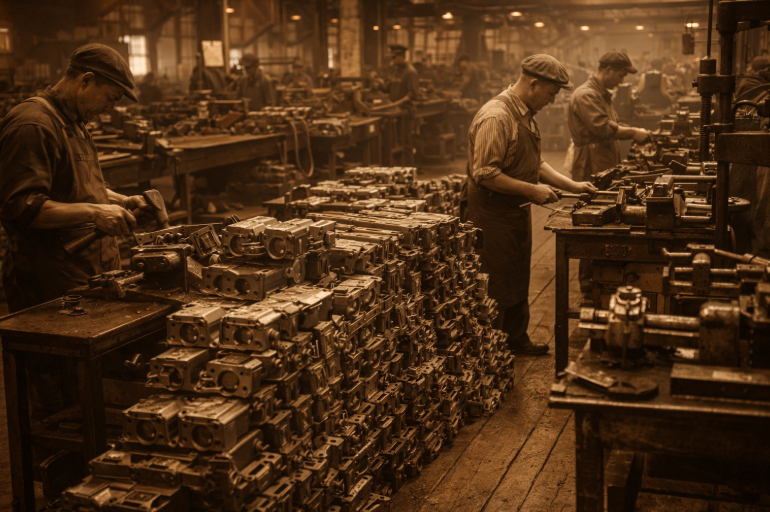
Early in the production of the Model T, Ford faced a paradox.
Demand was exploding.
Factories were busy.
Workers were constantly in motion.
Yet output stalled.
Parts piled up between stations.
Tasks overlapped.
Work changed hands without a clear sequence.
Everyone was working.
Unfortunately, the system wasn’t flowing.
The breakthrough didn’t come from hiring better people or asking for more effort.
It came from redefining how work moved.
Tasks were broken down.
Handoffs were clarified.
Sequence replaced improvisation.
The assembly line didn’t make people faster.
It made work transferable.
That’s the shift leaders need to make today:
Stop asking how to speed people up.
Start asking whether work can move cleanly without explanation.
What to Do
Here’s how to apply that shift in a practical, concrete way.
1. Define “ready,” not just “done”
Most leaders define completion.
Very few define readiness.
Before work changes hands, ask:
What must be true before this can move forward?
What information, decisions, or context must already exist?
If “ready” isn’t explicit, handoffs will slow execution every time.
2. Identify where work piles up
Don’t look for failure.
Look for accumulation.
Where does work tend to sit?
Between roles
Between meetings
Between approvals
Those pileups are signals that handoffs are unclear, not that people are underperforming.
3. Fix the handoff before fixing the person
When execution slows, leaders often coach harder, clarify expectations again, or reassign responsibility.
Instead, ask:
What’s unclear about this transfer of work?
Who owns the next decision?
What does success look like at the moment of handoff?
Most execution problems are design problems, not discipline problems.
4. Reduce interpretation at the edges
Every time someone has to interpret what to do next, momentum slows.
Your goal isn’t to remove judgment everywhere.
It’s to remove judgment where work should already be defined.
The less interpretation required at handoffs, the faster work compounds.
The Heartbeat
Leaders get trapped when activity masquerades as progress.
They mistake motion for momentum.
They confuse busyness with throughput.
Real leadership isn’t about pushing harder.
It’s about designing work that can move without you.
When work flows cleanly, leaders step out.
When it doesn’t, leaders get pulled back in.
Clarity at the handoff is one of the quiet disciplines that separates busy organizations from effective ones.
The Next Step
Where does work slow down in your organization
because it changes hands
before it’s truly ready to move?